

In performance management, blind spots are the disconnects between how an employee perceives their own behavior and how others actually experience it. They can also be a gap between the employee’s or leader’s own assessment of their work, and the reality of the quality of that work. It’s a fairly common issue, and there can often be a sharp contrast!
There are two main types of blind spots: overestimated strengths and underestimated impact. Let’s take a look at how to identify and address these issues as part of an effective performance management strategy.
Key Takeaways
- Blind spots are the disconnects between how a leader or other employee perceives their own behavior and how others actually experience it.
- There are two main types of blind spots: overestimated strengths and underestimated impact.
- Overestimated strengths occur when an employee takes a legitimate skill and pushes it so far that it actually causes more harm than good, without being aware of any problem.
- Overestimated strengths can be performance delusions (thinking one is better at one’s job than is actually the case) or overused strengths (when a person overuses one skill until it becomes a liability instead of an advantage).
- You can address performance delusion or an overused strength in a performance review, using the structure of the review process to ground events in facts and to clearly outline where problems exist and how they can be addressed.
- Underestimated impact happens when an employee is unaware of the negative effects of their own behavior.
- You can address underestimated impact in a performance review by connecting each small behavior to its bigger impact on the team and company.
- Coping with leadership blind spots involves relying on 360 degree reviews and performance reviews, which remain the most effective tools even within a continuous performance management setting.
- Dedicated performance management software, such as the full suite offered by Primalogik, can also help identify and address employee blind spots by gathering comprehensive data, collecting informal feedback, tracking behaviors, and presenting results in clear, non-biased reports.
Table of Contents
1. Overestimated Strengths Blind Spots
2. Underestimated Impact Blind Spots
3. How to Cope With Leadership Blind Spots
4. Performance Management Software Can Help Address Blind Spots
5. Try Primalogik’s Award-winning 360 Degree Software
1. Overestimated Strengths Blind Spots
An overestimated strength is a psychological phenomenon where a worker takes a legitimate skill and pushes it so far that it actually causes more harm than good, all while believing they are performing at a gold-medal level. Their blind spot is not being able to match their skill level with reality.
This blind spot usually manifests in two ways: as a performance delusion or an overused strength.
The Performance Delusion
In performance management, performance delusion is a manifestation of the Dunning-Kruger Effect, where a lack of self-awareness leads someone to believe they are significantly more competent in a specific area than they actually are.
Since the employee genuinely believes they are an expert in a skill they haven’t mastered, they stop seeking mentorship or learning new methods. They can think they are making a big impact by working overtime, when in fact they are just not able to complete tasks in the assigned time. They think they are excellent at communicating with clients or team members, but in reality, they are overbearing and people complain. They may have barely mastered their current role and yet are already demanding a promotion.
How to address performance delusion in a performance review
You cannot argue someone out of a delusion; you have to use objective anchors.
- During reviews, don’t just give them a rating. Show them the rubric for a Level 5 performer vs. a Level 3 performer. Ask them to provide a specific, documented example for every bullet point in the Level 5 column.
- Ask them to complete a self-assessment as part of the review process. Before the formal review, have them fill out a performance matrix such as a 9-box grid or do a skills gap analysis. When you meet, highlight the results.
- Use 360-degree feedback to show that you are not only discussing one person’s opinion. For example, if five peers say their documentation is unclear, the employee can no longer blame a personality clash with the manager.
The Overused Strength
Overused strength occurs when a person relies so heavily on a specific talent that it creates negative side effects. Leaders can pride themselves on being decisive, when in fact they have become arrogant and ignore others’ ideas. They can be proud of having high standards, yet not realize they are micromanaging and preventing others from contributing. They may think they are being direct, when in fact they are damaging morale and threatening the psychological safety of other employees. They may be focused on data, and not realize they are becoming unable to make decisions and move forward without charts and statistics to support their choices. An exceptionally kind person may find themselves becoming overly accommodating, and unable to address difficult issues.
How to address overused strength in a performance review
During a leadership review, help them understand that maximum intensity is perfect for some situations but destructive in others.
- Ask them to identify three different work scenarios. For example, a crisis, a brainstorming session, and a 1-on-1. Ask: What volume level (1–10) does your directness need to be at for each of these to be successful?
- For team members, you can also use the Stop-Keep-Start framework to provide different types of instructions. Address something you’d like them to stop, something you’d like them to keep doing, and something you’d like them to start doing.
- For every overused strength, there is a balancing skill that the employee is likely neglecting. You can frame this missing skill as the key to unlocking their next level of performance.
2. Underestimated Impact Blind Spots

Underestimated impact happens when an employee is unaware of the negative ripples their small, everyday behaviors cast across the team. They may unintentionally talk down to staff or team members, avoid challenging conversations, and value being right over collaboration. They may be late to meetings, not participate in group discussions, delay getting things done even when it impacts others’ ability to do their job, and vent their troubles on the group. They often think it is no big deal (they do mean well), while it actually has a significant impact on their team.
How to address underestimated impact in a performance review
Because these behaviors feel small to the employee, it’s important to connect the small behavior to the bigger picture when addressing the issue.
For example:
- Point out that if they were 10 minutes late to a meeting with 6 people, that isn’t 10 minutes of lost time; it’s 60 minutes of company salary time wasted waiting for them to start.
- Ask: If I asked the team to describe your reliability in one word, what would they say? Then, use insights from anonymous 360-degree feedback to add depth and nuance to that perspective.
- When delivering this feedback, always focus on observable behaviors rather than personality traits. Instead of saying they are arrogant, try: In meetings, you often interrupt others before they finish their point, which makes the team less likely to share new ideas.
- Use a visualization such as a Johari Window to demonstrate clearly the gap between their self-awareness and the perceptions of others.
How to Cope With Leadership Blind Spots
Real-time feedback and other elements of continuous performance management are trending in today’s workplaces, but when it comes to identifying and coping with blind spots, 360 degree reviews and performance reviews remain the most effective tools.
There are two steps to identifying blind spots:
- Assessing the employee’s performance and behavior and gathering evidence of any discrepancies. A 360 degree feedback process is best suited to this type of evaluation, since it provides a full view of the person’s performance in many areas.
- Addressing the issue during a performance review. A formal review setting provides the firm structure to support your analysis with data and guide your conversation with prescribed questions.
Performance Management Software Can Help Address Blind Spots
Dedicated performance management software can help identify and address employee blind spots. It can be used to:
- Gather comprehensive data from multiple sources during 360 degree reviews. This is the gold standard. Comparing self-assessments against anonymous feedback from all levels makes the gap mathematically visible.
- Collect feedback via more informal methods like surveys and check-ins.
- Track behaviors in a manager journal for easy reference.
- Offer transparent, real-time feedback to employees about their behavior. Why? Waiting for an annual review to mention a blind spot is a recipe for defensiveness. Mentioning a specific behavior right after a meeting is much more effective.
- Track and present objective results in the form of an official report.
Try Primalogik’s Award-winning 360 Degree Software
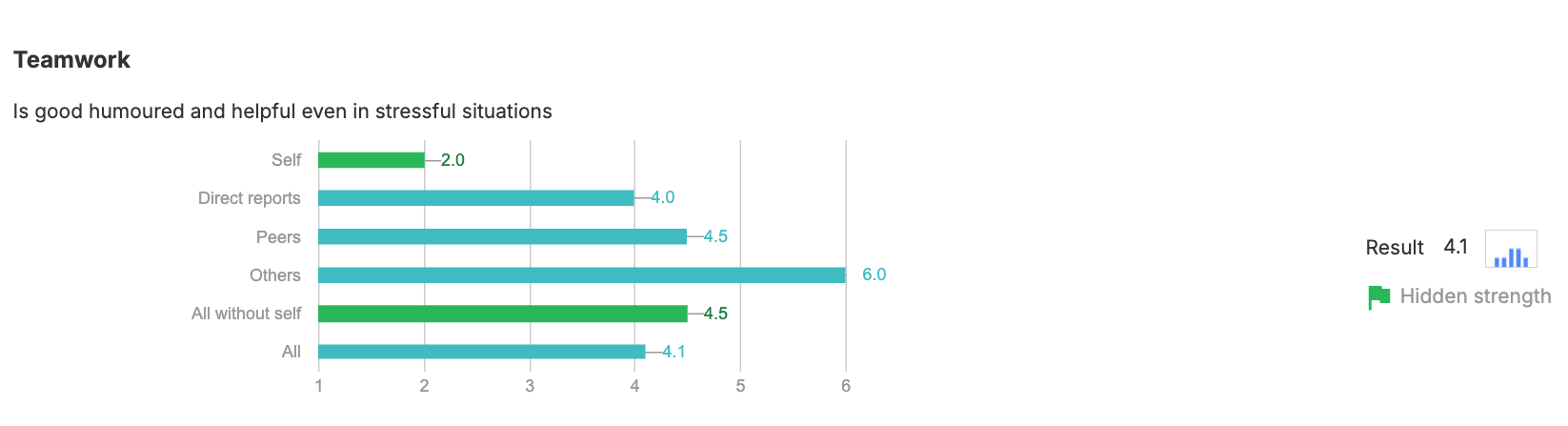
In the image below, see how Primalogik’s 360 degree review software tool clearly identifies the different respondent groups:
- Self
- Direct reports
- Peers
- Others
- All without self
- All
This makes it easy to see the discrepancy between the self-review and that of the other respondents, guiding both manager and employee to focus on these gaps.
Our full suite of performance management tools contains the necessary modules to identify, track and address employee and leadership blind spots, including performance review, goal tracking, employee surveys and instant feedback tools. Are you a startup or small business? Check out our platform and take the next step toward effective performance management. Book a demo today.